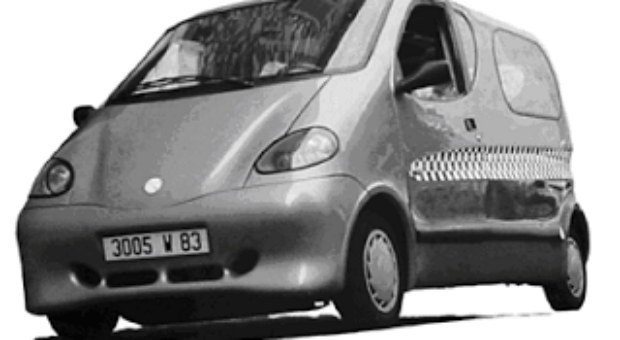
Meet the Air Pod. Its manufacturers think it could be the future of urban transport.

Can noncombustion technology create a no-pollution way to drive? Imagine pulling into a service station to fuel up your car. But not at the gas pump or electric battery charger—at the air pump! That’s not hot air, either!
The next generation of cars may run on thin air. Wouldn’t that be an incredible way to cut both pollution and dependence on foreign oil?
If you’ve ever inflated a balloon and then let it go, you’ve got the basics to test-drive the amazing MiniCAT, currently being developed by Moteur Développement International (MDI), headquartered in Luxembourg.
Invented by Formula One racing car designer Guy Nègre, this experimental vehicle is unlike any car you’ve ever seen. While your family’s traditional sedan or SUV draws its horsepower using combustion (flammable gasoline explodes inside the engine’s cylinders), the only fuel that MiniCAT needs (CAT stands for Compressed Air Technology) is the air we breathe.
Start with about 25,000 gallons of air (enough air to fill a small house). Now, squash it all into a space smaller than your school locker—because that’s the size of two super-strong, highpressure air tanks, custom-fabricated from exotic, spun-carbon fiber and mounted beneath the air car.
Talk about a tight squeeze! Confining that much air inside those little tanks (it’s done using special compressors) generates an internal pressure of over 4,000 pounds per square inch.
That’s over 300 times normal air pressure.
When this cold, high-pressure air enters MiniCAT’s unique, multichambered engine, it interacts with warmer air to create pressure waves that pump the engine’s ingeniously engineered pistons to propel the car. MiniCAT’s projected top speed is 60 miles per hour, with a range of 120 miles on a full air supply.
And pollution? Traditional internal combustion engines spew out carbon monoxide and other poisonous hydrocarbons, producing smog that is dangerous to human health and greenhouse gases that contribute to global warming. MiniCAT’s only exhaust is air—filtered so that it’s cleaner than the air we breathe. This negative contamination (called “minus pollution”) marks a revolutionary advance. While driving an ordinary car increases pollution, driving a MiniCAT actually cleans the atmosphere. That’s not just zero pollution—it’s even better!
Because there’s no fuel burned, this car’s air-exhaust comes out cold—so cold, at minus 22 degrees F, that you can blow it inside the car to produce no-cost air conditioning! In fact, this car’s advanced, four-cylinder engine runs so clean that it’s lubricated using just three and a half cups of vegetable oil! (Like you’d put in a salad—just change it every 30,000 miles!) The air car engineers are also experimenting with Earth-friendly body panels made from natural hemp fiber and mounted on an aircraft-inspired aluminum chassis.
With no combustion (explosions) in the engine’s cylinders, MiniCAT’s ride is extremely quiet. Need to slow down for a curve? MiniCAT’s brakes reduce the car’s speed—but they also refuel the car!
Called “regenerative braking,” this works by absorbing the energy of the car’s forward motion to operate a pump that raises the pressure in the air tanks. That extra pressure later helps run the car.
Stop at a red light, and the engine literally stops, too—another feature to conserve power. The really cool part is the engine’s automatic and instantaneous restart when you step on the gas pedal.
When it’s time to refuel, just pull into an air station—where in three minutes, via a highpressure hose, simply plug MiniCAT’s onboard electric air compressor into an ordinary wall socket (like running a tire pump from your car’s cigarette lighter). Projected cost to fill your tank? About two dollars—or 1.6 cents per mile.
Are you ready to take a test drive? Check this video:
Video: CNN | Text