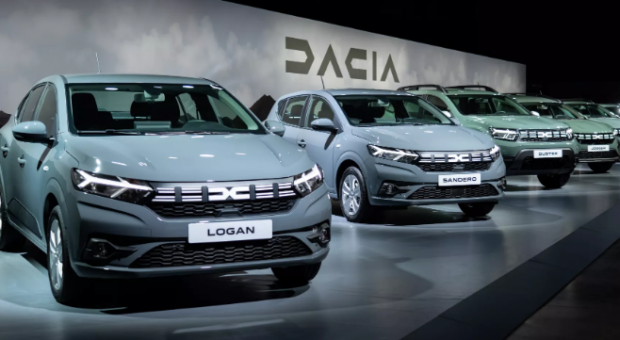
Renault Group presented the Renaulution, its new corporate strategic plan setting the course for each brand, on 14 January 2021. Its goal for Dacia was clear: become the leader for affordable mobility, the essential brand.
Its goal and vision are all the more fitting as they are building on a string of success stories: Dacia has sold 7.5 million cars in 18 years and sales to private customers rank the brand 3rd in Europe. Dacia now stands for a new angle on modernity, a vision of cars acclaimed by a growing number of no-nonsense customers who have money but spend it smartly, are keen on freedom and simple pleasures, and shun overconsumption.
On the strength of this track record and up-to-the-minute attitude, the Dacia brand is more synched with society than ever, will explore new territories and will bring to the C segment the values and virtues that propelled it to success in the B segment.
Twenty months after the Renaulution plan was presented, Dacia is ready and raring to go, and starting a new chapter in its history. It has decided to bolster its appeal and desirability without letting go of its value-for-money proposition. To do this, the brand has donned a new identity, new logo, new dealerships, new design and new colours in recent months.
Dacia’s new chapter kicked off, symbolically, during the Brand Manifesto days, which brought together several hundred international journalists at Le Bourget from 13 to 15 September last. It is grounded, in practice, in the reaffirmation of the three values that will guide the brand’s action and product design over the coming years.
ESSENTIAL AND COOL
These past 18 years, Dacia has been offering customers the essentials – and shown that they are enough.
Naturally, what is and isn’t essential changes over time. Air conditioning, for instance, wasn’t essential 18 years ago but is today. Conversely, what’s the point of fitting two or three screens in a car when there’s a swift and smart way to pair the owner’s smartphone with the vehicle, for example via Dacia’s Media Control system, to enjoy all the essential features?
Essential doesn’t mean rustic or austere. Dacia is also clever, creative and fetching. That applies to the practical aspects – with breakthroughs such as the Media Control system or the modular roof rack superseding the traditional version sold as an optional accessory. It also applies to the design: the look is cool – and doesn’t cost more!
Tomorrow, Dacia will take creativity one step further by adding a feature that suggests times and places to take a break on its smartphone app. This new feature is being developed by Dacia’s teams with the Software République ecosystem, which includes Renault Group.
ROBUST AND BUILT FOR OUTDOOR ADVENTURE
Dependability and sturdiness are two of the essentials that have powered Dacia’s success. Customer loyalty is the best example of this: in France, they keep their Dacia for 8 years on average and 60% of them replace it with another Dacia. Another example is Dacia’s best-value-for-money guarantee: a Dacia car’s residual value when you sell it second-hand is approximately 10 points higher than the average value of non-specialist rivals.
This robustness and reliability make Dacia cars ideal for the outdoor activities that a growing number of customers are enjoying during their time off as well as for professional endeavours.
Tomorrow, Dacia will take one step further in synch with this market trend by consolidating its range of models designed specifically for off-road driving. Dacia will continue to offer all-wheel drive systems and equipment designed for outdoor activities, including a kit that will be available in 2023 to set up a proper double bed in minutes in the Jogger without encumbering the boot. And a family of four will even be able to hitch a tent to the passenger compartment to enlarge their living area.
ECO-SMART: ECONOMICAL AND ECOLOGICAL
Dacia is intent on overlapping individual and collective interests. To do this, it uses tried and tested technologies, which save customers money, instead of developing new ones. One example is the existing CMF-B platform. Then, leaving out superfluous technology or merely cosmetic features makes cars lighter and thus saves fuel – which is good for owners’ wallets and the planet. Jogger, for instance, is 300 kg lighter than its main 7-seat rivals.
Using recycled materials extensively is another priority for Dacia. Accordingly, 12% of the plastic used in Duster is recycled – which is much more than the average for new cars in the European market. Here again, we are combining customers’ interests with the planet’s.
Tomorrow, Dacia will take one step further, using more recycled plastic in its models. The target is 20% of recycled plastic in the new-generation Duster. Achieving this will involve using recycled plastic for the parts that are out of sight, which is often the case today, and in the visible external parts, which is less so nowadays. Dacia started doing this with the skid plate under Sandero Stepway’s front bumper, and will take it to the next level with a new material fine-tuned by the brand’s engineers: Starkle®, an environmentally-friendly, robust, elegant recycled plastic compound.
Source: Renault Europe